MBTI Daily Guidance: How Personality Shapes Better Everyday Decisions
Discover how MBTI daily guidance can transform static personality types into practical reflection prompts for mindful, agency-driven decision making.
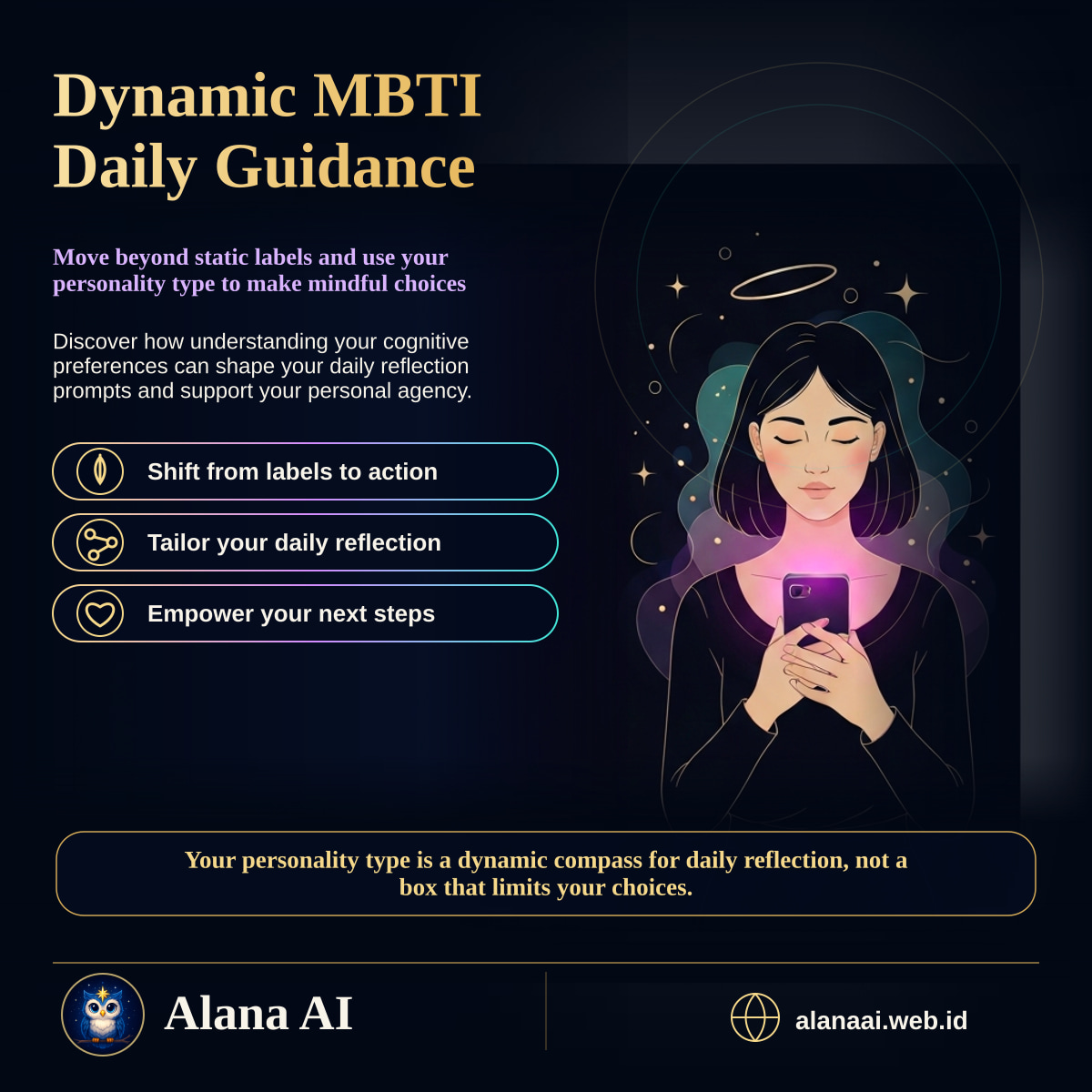
Your four-letter personality type isn't a box. Discover how MBTI decision making can guide your daily reflection and next-step choices.
Many of us first encounter the Myers-Briggs Type Indicator (MBTI) as a fun online quiz or a professional development exercise. We read our profile, nod in agreement at our strengths, shrug at our weaknesses, and then let those four letters sit quietly in the back of our minds. But static descriptions only tell half the story. When treated as an active tool rather than a rigid label, your personality type can offer profound, practical support for your daily choices.
Using personality type guidance in your daily routine isn't about predicting what you are going to do. Instead, it is about understanding how you process information, manage energy, and weigh options. By shifting our perspective from "Who am I?" to "How do I navigate today?", we unlock the true potential of mindful self-reflection.
Moving Beyond the Personality Box
It is easy to fall into the trap of using personality frameworks as an excuse for certain behaviors—such as saying, "I can't make quick decisions because I'm a Perceiver," or "I don't consider feelings because I'm a Thinker." However, true self-awareness means using these categories as mirrors, not boundaries.
Every personality type possesses a unique cognitive stack—a preferred way of gathering data and making judgments. When we seek out daily reflection that aligns with these preferences, we do not restrict ourselves. Rather, we learn to recognize our natural blind spots and lean into our innate strengths. This is where personalized tools, like a mindful AI personality app, can help you translate complex cognitive concepts into simple, actionable moments of clarity.
How MBTI Shapes Daily Decision Making
To understand how to apply this to your daily life, it helps to look at the core components of MBTI decision making. Every day, you are faced with dozens of choices, from how you respond to an email to how you prioritize your evening. Your cognitive preferences influence this process in two primary ways:
- How you gather information (Sensing vs. Intuition): Do you focus on immediate, concrete facts and past experiences (Sensing), or do you naturally look at the big picture, patterns, and future possibilities (Intuition)?
- How you evaluate options (Thinking vs. Feeling): Do you make choices based on objective logic, consistency, and cause-and-effect (Thinking), or do you prioritize values, interpersonal harmony, and the subjective impact on people (Feeling)?
When these preferences are out of balance, decision fatigue sets in. For example, a person who heavily favors Intuition might get lost in endless possibilities and struggle to take the first practical step. Conversely, someone who relies solely on Sensing might stick so closely to past routines that they miss creative solutions. By utilizing targeted MBTI daily guidance, you can gently prompt yourself to engage the opposite side of your cognitive preferences, leading to more balanced and conscious choices.
Practical MBTI Reflection Prompts for Daily Use
To help you move from theory to practice, here are specific MBTI reflection prompts designed to bring balance to your decision-making process. You can use these in your morning journal, during a quiet afternoon pause, or as part of your evening wind-down routine.
For the Intuitive-Feeling (NF) Types (The Visionaries & Diplomats)
NF types naturally focus on future possibilities and personal values. Your strength lies in empathy and long-term vision, but you may sometimes struggle with practical details or objective boundaries.
- Morning Alignment: "What is one practical, concrete step I can take today to bring my larger vision to life?"
- Decision Check-In: "Am I avoiding a necessary boundary today simply to maintain temporary peace? How can I communicate my needs with both kindness and clarity?"
- Evening Reflection: "Where did I feel a genuine sense of connection today, and how did that support my personal values?"
For the Sensing-Thinking (ST) Types (The Pragmatists & Organizers)
ST types excel at objective analysis, logical consistency, and practical execution. Your strength is your grounded efficiency, but you might occasionally overlook the emotional undertones of a situation.
- Morning Alignment: "As I plan my tasks today, who are the people impacted by my choices, and how can I factor their perspectives into my plans?"
- Decision Check-In: "Am I choosing the most efficient path, or the path that genuinely aligns with my deeper purpose?"
- Evening Reflection: "What is one moment of quiet appreciation or emotional connection I experienced today that had nothing to do with productivity?"
For the Intuitive-Thinking (NT) Types (The Strategists & Analysts)
NT types love complex problem-solving, systems, and strategic planning. You are naturally innovative, but you may find yourself overthinking simple decisions or neglecting your immediate physical needs.
- Morning Alignment: "What is one area of my life today where I can practice accepting things as they are, rather than trying to optimize or solve them?"
- Decision Check-In: "Am I delaying action because I am waiting for perfect information? What is the simplest, most direct step forward right now?"
- Evening Reflection: "How did I honor my physical well-being today while pursuing my mental goals?"
For the Sensing-Feeling (SF) Types (The Supporters & Harmonizers)
SF types are deeply attuned to the practical needs of those around them and seek to create supportive, harmonious environments. Your strength is your warm helpfulness, but you can easily experience burnout by prioritizing others over yourself.
- Morning Alignment: "What is one small act of self-care or personal nourishment I will prioritize today before tending to the needs of others?"
- Decision Check-In: "Am I making this choice out of a sense of obligation, or does it truly align with my authentic energy?"
- Evening Reflection: "How did I experience joy in the present moment today, free from the pressure of external expectations?"
Integrating Personality Type Guidance into Your Routine
Bringing these prompts into your life does not require hours of study. It is about creating a gentle, consistent space for self-inquiry. Here is how you can seamlessly weave this practice into your day:
- Start Small: Choose just one prompt that resonates with your current state. You do not need to answer every question every day.
- Embrace the Pause: Before making a significant decision, take three deep breaths and ask yourself how your natural preferences might be influencing your view. Are you rushing to a logical conclusion without checking your heart? Or are you feeling overwhelmed by emotion without looking at the facts?
- Use Supportive Tools: If you find it challenging to remember these prompts, a dedicated AI personality app can act as a gentle companion. Rather than offering deterministic predictions or telling you what to do, a mindful tool can suggest the right questions at the right time, helping you return to your own inner wisdom.
Preserving Your Agency
At Alana AI, we believe that any self-reflection tool—whether it is MBTI, Human Design, or Numerology—should always preserve your personal agency. These frameworks are not meant to dictate your path or tell you what your future holds. They are simply lenses to help you see yourself more clearly.
Your choices remain entirely your own. By using personality type guidance as a daily reflective practice, you cultivate the self-awareness needed to make decisions that feel authentic, balanced, and aligned with your true self.
If you are curious to explore more ways to integrate mindful self-reflection into your daily life, feel free to browse our blog for gentle guidance, rituals, and practical tools designed to support your personal journey.