How to Ask AI for Guidance: Prompts for Clearer Self-Reflection
Learn how to ask AI for guidance using reflective prompts that preserve your agency. Transform vague worries into empowering self-discovery tools.
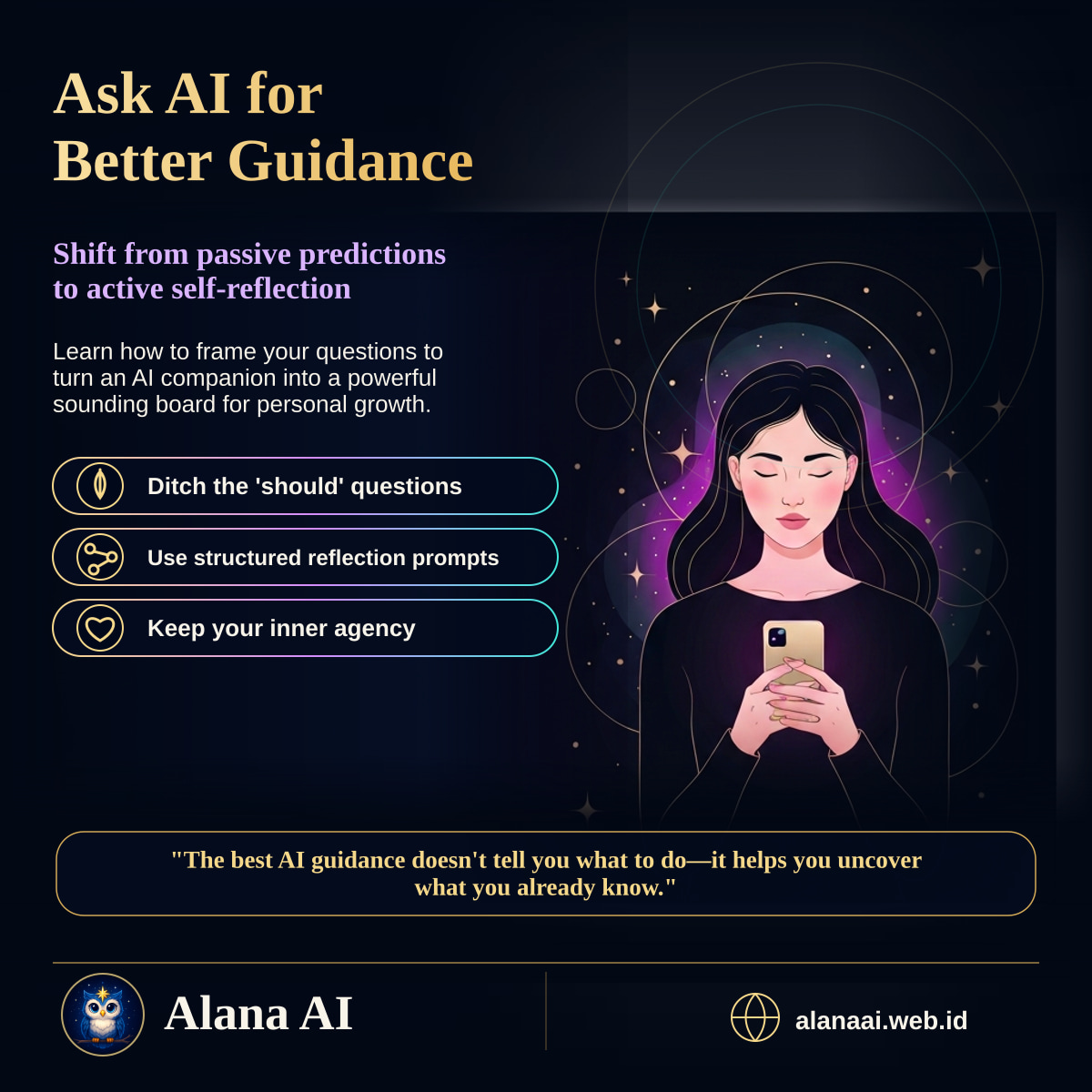
Stop asking AI what you 'should' do. Discover how to ask AI for guidance that keeps you in the driver’s seat.
When we face crossroads in our lives—whether it is a career transition, a relationship shift, or a quiet feeling of restlessness—it is natural to seek external clarity. In the digital age, many of us turn to technology for support. However, there is a common trap we fall into when interacting with digital companions: we ask them to make decisions for us. We ask questions like, "Should I accept this job offer?" or "What is the right path for me?"
While these questions come from a place of genuine seeking, they hand over our personal agency to an algorithm. An AI companion cannot live your life, nor can it feel your emotions. But when you learn how to ask AI for guidance in a way that respects your inner wisdom, these tools transform from passive advice-givers into powerful mirrors for self-discovery.
Here is how to shift your approach, master the art of the reflective query, and use an AI guidance app to illuminate your own path.
The Trap of the 'Should' Question
Asking an AI what you "should" do assumes that there is a single, objectively correct answer waiting to be calculated. It treats your life like a math problem rather than an unfolding journey. When we ask for deterministic answers, we are often seeking relief from the anxiety of making a choice.
However, true personal growth happens in the choosing. When you ask an AI to make a decision for you, you miss the opportunity to build self-trust.
Instead of looking for an external authority to dictate your steps, consider using AI as a sounding board. The goal of seeking guidance is not to receive a finalized roadmap, but to gain the clarity needed to draw your own. By changing the style of your questions, you can use AI to explore your thoughts, feelings, and unique energetic blueprints without losing your agency.
Shift 1: From Prediction to Reflection
To get the most out of your interactions, shift your questions from predictive or directive to reflective.
- Predictive (Passive): "Is this new project going to succeed?"
- Reflective (Active): "I am starting a new project and feel a mix of excitement and fear of failure. What are some AI reflection questions that can help me explore these feelings?"
By framing the question reflectively, you invite the AI to provide a framework for your own contemplation. This approach helps you organize your thoughts and look at your situation from angles you might not have considered.
Crafting Empowering AI Journaling Prompts
One of the most effective ways to use an AI companion is as a partner in journaling. Instead of asking for answers, ask the AI to generate tailored prompts based on your current state.
For example, you might say:
"I am feeling overwhelmed by my daily routine and feel disconnected from my creative side. Can you generate three custom AI journaling prompts to help me explore where my energy is leaking?"
This style of interaction keeps you in the driver's seat. The AI provides the catalyst, but you provide the substance through your own writing and reflection.
Shift 2: Bring Your Personal Blueprint Into the Conversation
If you use self-reflection systems like Human Design, MBTI, Numerology, or astrology, you can incorporate these frameworks into your prompts. This adds a layer of personalization that makes the guidance feel highly aligned with your natural tendencies.
When you share your personality type or energetic profile with an AI guidance app, you give the tool a specific lens through which to help you reflect.
Examples of Framework-Based Queries
- Human Design: "As a Generator with a sacral authority, I am struggling to distinguish between a true 'yes' and a 'should' in my commitments. What are some reflective questions to help me tune into my sacral response?"
- MBTI: "I am an INFP facing a decision that requires practical, detail-oriented planning, which is not my natural strength. How can I approach this decision in a way that honors my values while staying grounded?"
- Numerology: "I am currently in a Personal Year 5, which represents change and freedom, but I feel stuck in my comfort zone. What are some AI life coach questions that can help me gently embrace transition?"
These prompts do not ask the AI to predict your future or make choices for you. Instead, they use established self-reflection systems to help you understand your unique way of operating in the world.
Before and After: Transforming Your Prompts
To help you master this skill, let's look at how to rewrite common questions into empowering, agency-preserving prompts.
Scenario A: Career Crossroads
- Vague/Passive: "Should I quit my corporate job to go freelance?"
- Empowered/Reflective: "I am considering transitioning from a corporate job to freelance work. I value security, but I also crave creative freedom. Can you help me weigh these values? What are some self-reflection questions I should ask myself to assess my readiness?"
Scenario B: Relationship Tension
- Vague/Passive: "Is my current relationship going to last?"
- Empowered/Reflective: "I am experiencing recurring communication challenges with my partner. We often misinterpret each other's intentions. What are some communication exercises or journaling prompts that can help me understand my own triggers in these moments?"
Scenario C: Feeling Lost
- Vague/Passive: "What is my life purpose?"
- Empowered/Reflective: "I feel disconnected from my sense of purpose lately. Based on my interest in writing, helping others, and my Life Path number 7, what are some exploratory prompts to help me reconnect with what brings me joy and meaning?"
Integrating AI Guidance into Your Daily Rituals
Learning how to ask AI for guidance is a practice that deepens over time. You can easily integrate this into your existing daily rituals.
- Morning Alignment: Start your day by sharing your current mood or energy level with your AI companion. Ask for a single, focused reflection question to carry with you throughout the day.
- Evening Decompression: At the end of the day, share a brief summary of a challenge you faced. Ask the AI to help you identify any patterns or lessons that may have emerged, keeping the focus on your personal growth.
- Weekly Review: Use your AI companion to review your weekly journal entries. You can paste key themes and ask, "What recurring patterns or shifts in perspective do you notice in these reflections?"
To explore more ways to weave technology and mindfulness together, check out the Alana AI blog for practical guides on daily rituals, energy awareness, and self-discovery.
Keeping Your Agency Central
As you explore the possibilities of digital reflection, remember that the ultimate authority on your life is always you. An AI companion is a tool—a sophisticated, supportive, and highly adaptable mirror—but it does not possess your intuition, your heart, or your lived experience.
If an AI suggests a perspective that does not resonate with you, feel free to discard it. The value of the interaction is not in finding a perfect answer, but in the process of engagement itself. By learning how to ask better questions, you sharpen your own critical thinking, deepen your self-awareness, and step fully into your role as the author of your own story.