Gentle Moon Phase Reflection: A Guide to Cyclical Planning
Explore how to use gentle moon phase reflection and new moon journal prompts for spiritual planning without the pressure of rigid goal-setting.
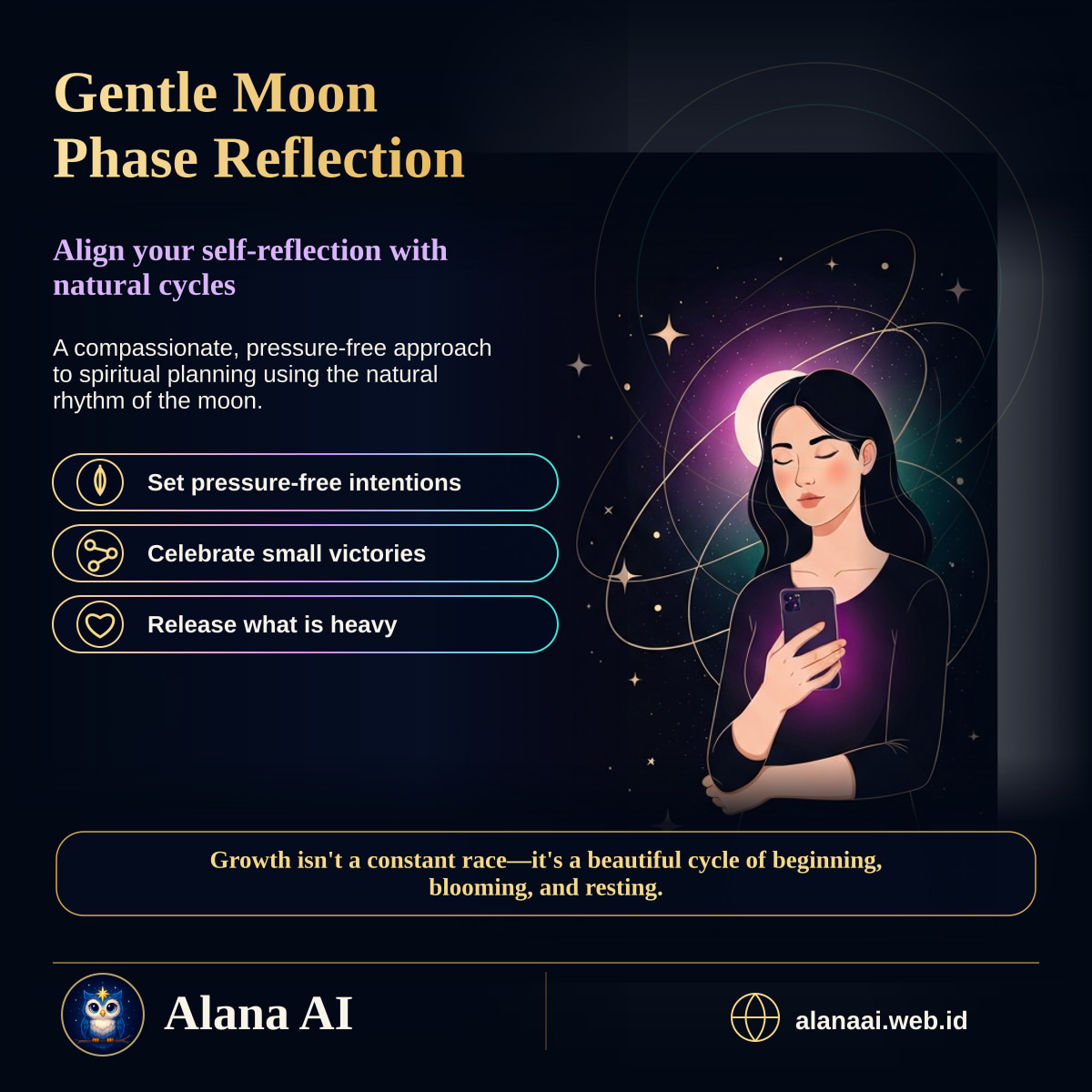
What if your goal-setting felt more like a natural cycle? These new moon journal prompts help you begin again without the pressure.
In our modern, fast-paced world, we are often encouraged to operate in a strictly linear fashion. We are told to set rigid quarterly goals, push through fatigue, and maintain a constant upward trajectory of productivity. But human beings are not machines; we are part of nature, and nature moves in cycles. When we force ourselves to constantly produce, we risk burnout and disconnection from our inner world.
This is where a gentle moon phase reflection practice can offer a breath of fresh air. By aligning your self-reflection with the natural rhythm of the moon, you can embrace a more compassionate approach to personal growth. Instead of viewing life as a constant race, you can see it as a series of phases—each with its own purpose, energy, and invitation for self-discovery.
Using the moon as a symbolic guide allows us to engage in spiritual planning that honors our natural energy fluctuations. It is not about fortune-telling or believing that the stars dictate our actions. Rather, it is about using the lunar cycle as a beautiful, recurring clock that prompts us to pause, look inward, and adjust our sails. Let’s explore how you can use these different phases as gentle themes for your own reflective journey.
The Philosophy of Cyclical Reflection
Many people feel intimidated by astrology because it can sometimes feel complex, rigid, or even predictive. However, you do not need to memorize complicated birth charts or worry about planetary retrogrades to benefit from the moon's rhythm. At its heart, moon-centered reflection is simply a tool for mindfulness.
When we look at the moon, we see a visual representation of change. The moon grows from a sliver of light to a brilliant sphere, and then slowly fades back into darkness. This cycle repeats every twenty-nine and a half days, offering us a regular opportunity to reset. By mapping our internal reflection to these external phases, we give ourselves permission to experience a full spectrum of emotions and states of being. We learn that it is okay to shine brightly, and it is equally okay to retreat into quiet contemplation.
The New Moon: Beginning Without Pressure
The new moon represents a clean slate. The night sky is dark, offering a quiet canvas for quiet contemplation. In traditional goal-setting, a new beginning often comes with a long list of demands and high expectations. In a cyclical practice, however, the new moon is a time to plant seeds gently, without demanding that they sprout overnight.
To help you ease into this phase, try using these new moon journal prompts during the next dark moon. They are designed to help you focus on how you want to feel, rather than just what you want to achieve:
- What area of my life is calling for a quiet, gentle restart right now?
- If I could let go of the pressure to be perfect, what small intention would I love to plant today?
- How can I support my energy levels as I begin this new cycle?
- What is one small, daily habit that could bring me closer to a sense of inner peace?
- In what ways can I practice self-compassion if things do not go exactly as planned?
By focusing on intentions rather than rigid rules, you allow your goals to evolve naturally. This approach keeps your agency at the center of your growth.
The Waxing Moon: Cultivating and Spiritual Planning
As the moon begins to show a sliver of light, it enters the waxing phase. This is a time of gradual building and action. In the context of spiritual planning, the waxing moon invites us to take small, sustainable steps toward the intentions we set during the new moon.
This phase is not about frantic multitasking; it is about steady, mindful cultivation. It is a time to ask yourself: What resources, habits, or supportive relationships do I need to nurture my intentions?
During this phase, your reflection might focus on action steps that feel nourishing rather than exhausting. If you find yourself hitting a wall of resistance, use this phase to explore that feeling with curiosity rather than judgment. Resistance is often just a sign that a particular approach needs a gentle adjustment.
The Full Moon: Celebration and Deep Reflection
When the moon reaches its peak brightness, we enter the phase of the full moon reflection. The full moon illuminates the night sky, symbolizing a time of clarity, high energy, and completion.
In a gentle spiritual practice, the full moon is not a deadline; it is a mirror. It is an opportunity to look back at the past two weeks and notice what has come to fruition, what is working well, and what might be causing friction. Rather than focusing on what you failed to do, use this phase to celebrate your progress—no matter how small.
Here are a few questions to guide your next full moon reflection:
- What small victories or moments of joy have I experienced over the last two weeks?
- What is currently illuminated in my life? (What am I becoming more aware of?)
- Where am I experiencing tension, and what might that tension be trying to teach me?
- How can I express gratitude for the lessons this cycle has brought so far?
By taking time to celebrate and acknowledge your journey, you build a healthier relationship with your personal growth. You begin to see that even the challenges are valuable pieces of the puzzle.
The Waning Moon: Releasing and the Moon Phase Ritual
As the light of the moon begins to decrease, we enter the waning phase. This is a natural time for letting go, clearing out physical and mental clutter, and resting.
Many people find it helpful to create a simple, grounding moon phase ritual during this time to symbolize the act of releasing. A ritual does not need to be elaborate to be powerful. It can be as simple as writing down a worry on a piece of paper and safely shredding it, or taking a warm bath with the intention of washing away the stress of the past month.
As you practice your waning moon ritual, consider these reflective questions:
- What thoughts, expectations, or habits am I carrying that no longer serve my well-being?
- How can I create more space for rest and recovery in my schedule this week?
- What am I ready to release to make room for the next new moon?
This phase reminds us that letting go is a necessary part of growth. Just as trees shed their leaves in autumn to prepare for winter, releasing what is heavy can help us eventually begin again with a lighter heart.
Supporting Your Journey with Mindful Tools
Adopting a cyclical lifestyle is a beautiful journey of self-discovery, but it can sometimes be hard to know where to start or how to interpret your reflections. Incorporating supportive tools can make this practice feel more accessible and grounded.
If you are looking for a private, gentle space to explore these themes, Alana AI can serve as a supportive companion. Unlike traditional astrology tools that make rigid predictions or tell you what your future holds, Alana is designed to act as an emotionally intelligent sounding board. You can share your journal entries, explore your current energy levels, or ask for personalized prompts based on your Human Design, MBTI, or current moon phases.
By using Alana to support your spiritual planning, you retain complete agency over your path. The insights provided are meant to spark reflection and self-awareness, helping you connect more deeply with your own inner wisdom. You can explore more articles on mindful living and self-discovery by visiting our blog, where we regularly share practical tips for a balanced, soul-led life.
Embracing Your Own Rhythm
There is no right or wrong way to practice a moon phase reflection. The goal is not to adhere to a perfect schedule, but to find a rhythm that feels supportive and sustainable for you. Some months, you might find yourself deeply engaged with every phase; other months, you might only have the energy for a quick five-minute journal session during the new moon.
Allow your practice to be as fluid and changing as the moon itself. By releasing the pressure to perform and embracing the natural flow of beginning, building, noticing, and letting go, you can cultivate a deeper sense of peace and alignment in your daily life.