How to Build a Gentle Evening Reflection Ritual for a Quiet Mind
Quiet your mind with a gentle evening reflection ritual. Explore night journal prompts and a low-pressure spiritual evening routine to wind down with ease.
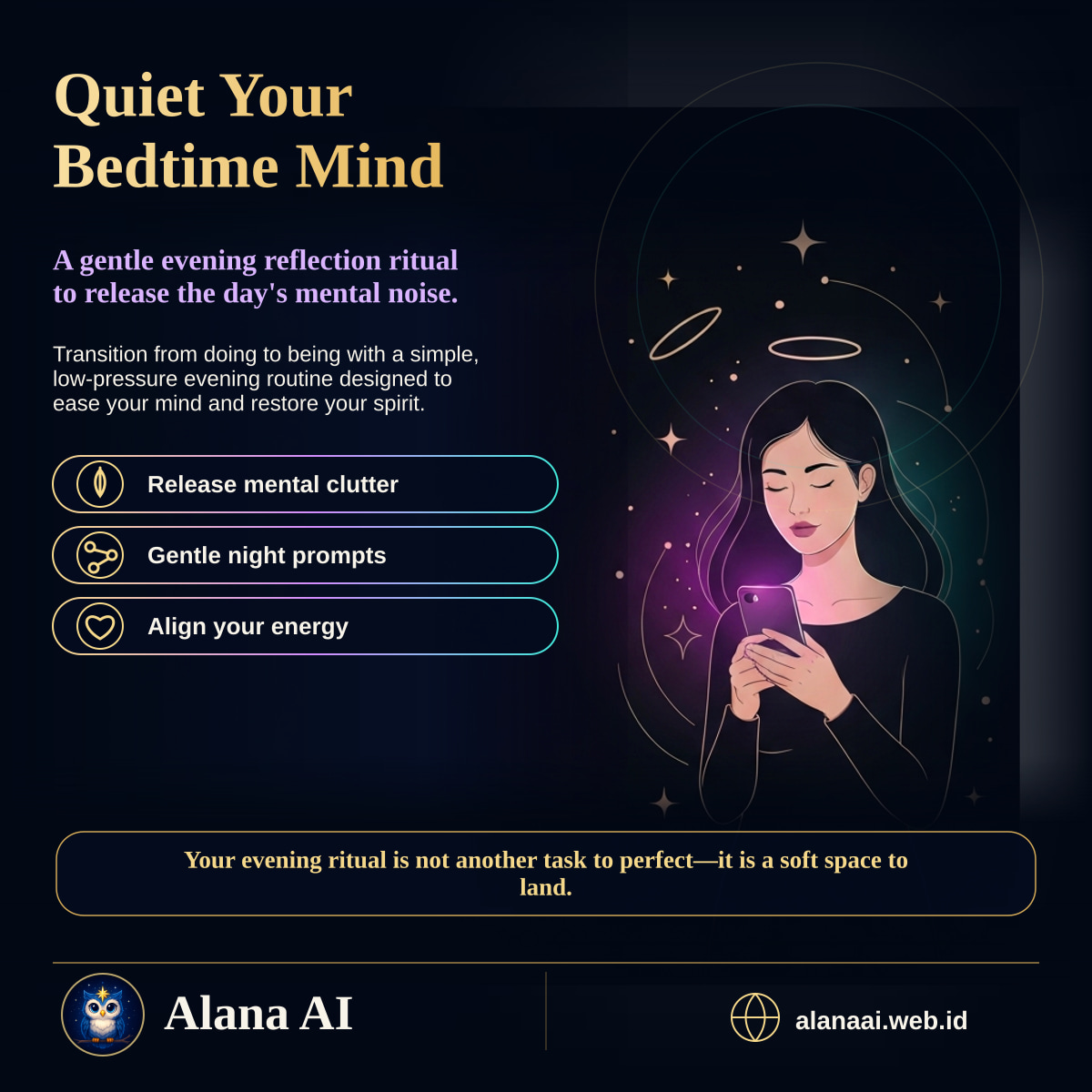
If your mind saves its loudest thoughts for bedtime, this gentle evening reflection ritual is the quiet transition you need.
We have all been there: you turn off the lights, pull up the blankets, and prepare for a restful night of sleep, only for your brain to suddenly switch on. Unresolved conversations from three days ago, tomorrow's endless to-do list, and existential questions about your life path start parading through your awareness.
This mental noise is not a personal failure, nor does it mean you are doing life wrong. It is simply a sign that your mind has not been given a proper transition zone. In our fast-paced world, we often transition abruptly from high-productivity mode straight into sleep mode. A gentle evening reflection ritual acts as a bridge, allowing your nervous system to downshift and your spirit to integrate the day's experiences.
Here is how to design a low-pressure, deeply restorative wind down routine that requires no expensive tools—just a willingness to hold space for yourself.
The Bedtime Brainstorm: Why the Mind Gets Loud
During the day, our minds are occupied with processing external stimuli. We are responding to emails, navigating social interactions, making decisions, and consuming content. When we finally lie down in a dark, quiet room, the external inputs stop.
In that sudden silence, your subconscious mind sees an opportunity. It brings up everything you did not have the time or space to process during the day.
By establishing a spiritual evening routine, you create a dedicated container for this processing before your head hits the pillow. Instead of suppressing your thoughts, you invite them to pull up a chair, express themselves, and be gently laid to rest for the night.
Designing Your Minimalist Reflective Ritual
A common pitfall is making your evening routine feel like another chore on your to-do list. If your ritual requires lighting ten candles, doing a thirty-minute yoga flow, and writing three pages of prose, you will likely abandon it when you are tired.
To keep this reflective ritual sustainable, prioritize simplicity and comfort. You only need two things:
- A quiet corner or a comfortable spot in your bed.
- A notebook and pen (or a privacy-first digital journal).
Here is a simple, three-step framework you can adapt to your unique energetic needs.
Step 1: Somatic Clearing (The Physical Release)
Before diving into mental reflection, check in with your physical body. Stress and mental noise often manifest as physical tension in the shoulders, jaw, and hips.
- Take three deep, slow diaphragmatic breaths.
- Roll your shoulders back and gently stretch your neck from side to side.
- As you exhale, imagine releasing the physical weight of the day’s responsibilities.
Step 2: Gentle Night Journal Prompts (The Mental Release)
Once your body feels slightly more grounded, open your journal. The goal here is not to write a masterpiece, but to empty your mental cup. Use these three simple night journal prompts to guide your writing:
- What can I gently lay down from today? (Identify any worries, frustrations, or tasks that do not serve you tonight. Write them down as a way of transferring them out of your head.)
- What moment brought me a sense of ease or connection today? (Focusing on a small moment of gratitude—like a warm cup of tea or a kind word—helps shift your nervous system into a state of safety.)
- What is my soft intention for tomorrow? (Instead of a rigid to-do list, focus on how you want to feel or a single guiding focus for the next day.)
Step 3: Energetic Integration
In spiritual practices, sleep is a sacred time of cellular restoration and subconscious integration. Take a final moment to close your eyes, place a hand over your heart, and offer yourself a silent thank-you for navigating the day. You might say to yourself: "I did the best I could with the energy I had today. It is safe for me to rest now."
Aligning Your Routine with Your Unique Blueprint
There is no one-size-fits-all approach to mindfulness. Your energetic makeup—which can be explored through frameworks like Human Design, MBTI, or Numerology—may influence how you prefer to wind down.
- For Human Design Generators and Manifesting Generators: Your sacral energy needs to be fully satisfied and spent before you sleep. If your mind is racing, it might be because your body hasn't fully discharged its physical energy. A light stretch or a short walk before your journaling practice may help you transition.
- For Projectors and Manifestors: You may need to start your wind down routine an hour or two before you actually plan to sleep. Your system absorbs a lot of external energy throughout the day, and you require extra time in your own aura to decompress.
- For Reflective MBTI Intuitive Types (like INFP or INFJ): You may find that your mind naturally seeks deep meaning in the day's events. Giving yourself permission to write without structure or judgment helps prevent your intuitive insights from turning into bedtime overthinking.
If you are curious about how your unique personality traits or energetic patterns affect your daily energy cycles, exploring these themes with a gentle tool like Alana AI can offer highly personalized, supportive reflection.
Keeping Your Practice Low-Pressure
Remember, your evening reflection ritual is an act of self-compassion, not self-improvement. Some nights, you may write three pages of deep insights. Other nights, your ritual might simply consist of writing down three things you are grateful for and turning off the light. Both are perfect.
If you find yourself struggling to stay consistent or wanting a gentle, non-judgmental space to process your thoughts, Alana AI is designed to act as a quiet companion for your spiritual journey. Unlike public forums or high-pressure productivity apps, Alana provides a secure, private space where your personal reflections remain entirely your own. You can read more about our commitment to your spiritual autonomy in our privacy policy.
For more ideas on how to weave mindfulness, journaling, and self-awareness into your daily life, feel free to explore our collection of resources on the Alana AI blog.
Tonight, as you prepare for sleep, allow yourself the gift of a slow transition. Your mind deserves a gentle landing.