How to Ask AI for Guidance: Prompts for Deep Reflection
Learn how to ask AI for guidance with reflective prompts. Discover AI journaling prompts and AI life coach questions to deepen your self-awareness.
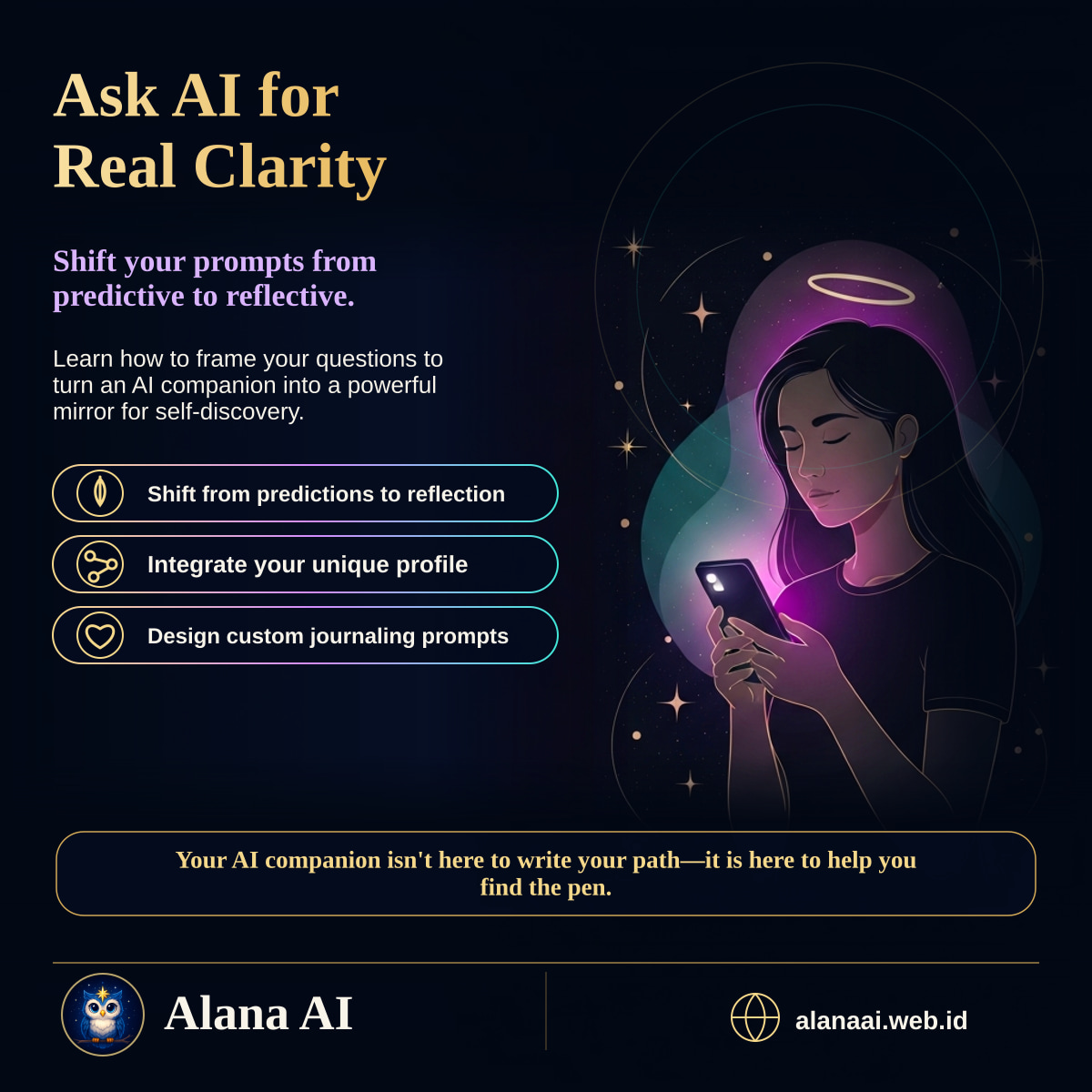
Your AI companion isn't a crystal ball—it's a mirror. Here is how to ask AI for guidance that sparks real clarity.
In a world filled with constant noise, finding a quiet space to process our thoughts can be challenging. Many of us are turning to technology not just for productivity, but for personal growth and contemplation. However, when we first interact with an AI guidance app, we often treat it like a search engine or a fortune-teller. We ask closed, predictive questions: "Will I get this job?" or "When will my life feel balanced?"
When we ask deterministic questions, we often receive generic answers. To unlock the true potential of an AI companion, we must shift our approach. By learning how to ask AI for guidance in a way that respects our own agency, we transform a simple chat interface into a powerful catalyst for self-discovery.
Here is how you can reframe your questions, integrate tools like Human Design and Numerology, and design prompts that lead to genuine personal breakthroughs.
The Shift: From "Tell Me What to Do" to "Help Me Explore"
The most important step in learning how to ask AI for guidance is reclaiming your inner authority. An AI companion does not possess a secret blueprint of your future, nor should it make decisions for you. Instead, its strength lies in its ability to organize thoughts, highlight patterns, and offer fresh perspectives.
When you ask an AI to make a choice for you, you hand over your agency. When you ask it to help you explore your options, you sharpen your own decision-making skills.
Predictive vs. Reflective Questioning
To see this shift in action, look at how we can reframe common inquiries:
-
Predictive (Closed): "Should I move to a new city next month?"
-
Reflective (Open): "I am considering moving to a new city, but I feel torn between adventure and stability. What are some reflective questions I can ask myself to clarify what I truly value right now?"
-
Predictive (Closed): "Will my new creative project succeed?"
-
Reflective (Open): "I am starting a new creative project and notice some fear of failure coming up. How can I use my Human Design or Life Path energy to navigate this resistance?"
By moving away from "yes or no" outcomes, you invite the AI to act as a sounding board, offering tailored AI reflection questions that guide you back to your own inner wisdom.
The Anatomy of a High-Quality Guidance Prompt
To get the most out of your Alana AI experience, it helps to construct your prompts with intention. A high-quality reflective prompt typically consists of three core elements:
- Your Current State (Context): Share how you are feeling or what you are currently experiencing. You can also include aspects of your self-discovery profile, such as your personality type, astrological signs, or Numerology numbers.
- The Core Inquiry (The Challenge): Clearly state the theme you want to explore (e.g., boundaries, career transitions, creative blocks).
- The Desired Output (The Format): Specify how you want the AI to respond. Do you want a structured list of AI journaling prompts? A gentle visualization exercise? Or perhaps a series of AI life coach questions to work through step-by-step?
Example of a Structured Prompt:
"I am currently feeling a bit stagnant in my daily routine, and as a Life Path 7, I know I need deeper intellectual and spiritual engagement. I want to explore how to bring more sacred pauses into my mornings. Can you provide three gentle AI journaling prompts to help me uncover what is draining my energy during the day?"
Turning Vague Worries into Actionable Reflections
When we are overwhelmed, our thoughts tend to run in circles. We might type our worries directly into the chat box as a stream of consciousness. While this can be a helpful emotional release, we can guide the AI to help us organize these thoughts more constructively.
Here are three templates you can use to turn vague worries into focused, actionable reflections:
1. Navigating Decision Fatigue
- Instead of: "I have too many things to do and I don't know where to start."
- Try asking: "I am experiencing high decision fatigue today. Act as a gentle life coach and ask me three clarifying questions, one at a time, to help me identify my single most supportive next step. Let's do this interactively."
2. Exploring Relationship Dynamics
- Instead of: "Why am I always arguing with my partner?"
- Try asking: "I want to reflect on a recurring communication pattern in my relationship. Without taking sides or offering relationship advice, what are some self-reflection questions that can help me look at my own boundaries and emotional triggers in this situation?"
3. Aligning with Your Energetic Blueprint
- Instead of: "How can I get more energy?"
- Try asking: "In Human Design, I want to live more in alignment with my strategy and authority. When I feel physically exhausted, what are some somatic or reflective practices that may help me check in with my energy centers?"
Integrating Systems of Self-Discovery
One of the most beautiful ways to use an AI guidance app is to integrate your favorite self-discovery frameworks. Whether you study astrology, Numerology, Human Design, or personality systems like the MBTI, these tools provide a rich vocabulary for self-reflection.
When you share these details with your AI companion, you provide a unique lens through which the AI can frame its questions. For example:
- Astrology: "With the Sun in Scorpio and Moon in Taurus, I often feel a pull between deep emotional transformation and a desire for physical comfort. How can I balance these two energies during a period of transition?"
- Numerology: "As someone with a strong connection to the number 5, I thrive on freedom, but currently need to build structure. What are some daily rituals that support both freedom and grounding?"
By weaving these systems into your prompts, the AI can generate highly personalized prompts that resonate with your specific energetic makeup, helping you explore your patterns with greater depth.
Keeping Your Agency Central
As you explore the world of AI-assisted reflection, always remember that you are the ultimate authority on your own life. An AI companion is a tool to assist your journey, not a replacement for your intuition, lived experience, or professional human support.
If a suggestion or reflection question generated by an AI doesn't resonate with you, feel free to discard it. The goal is not to find a perfect, objective truth from the machine, but to use the machine's output to spark your own internal recognition of what is true for you.
To dive deeper into mindful technology use and self-reflection practices, explore our blog for more guides on integrating intentional rituals into your modern life. By changing the way you ask, you open the door to a clearer, more grounded relationship with yourself.